
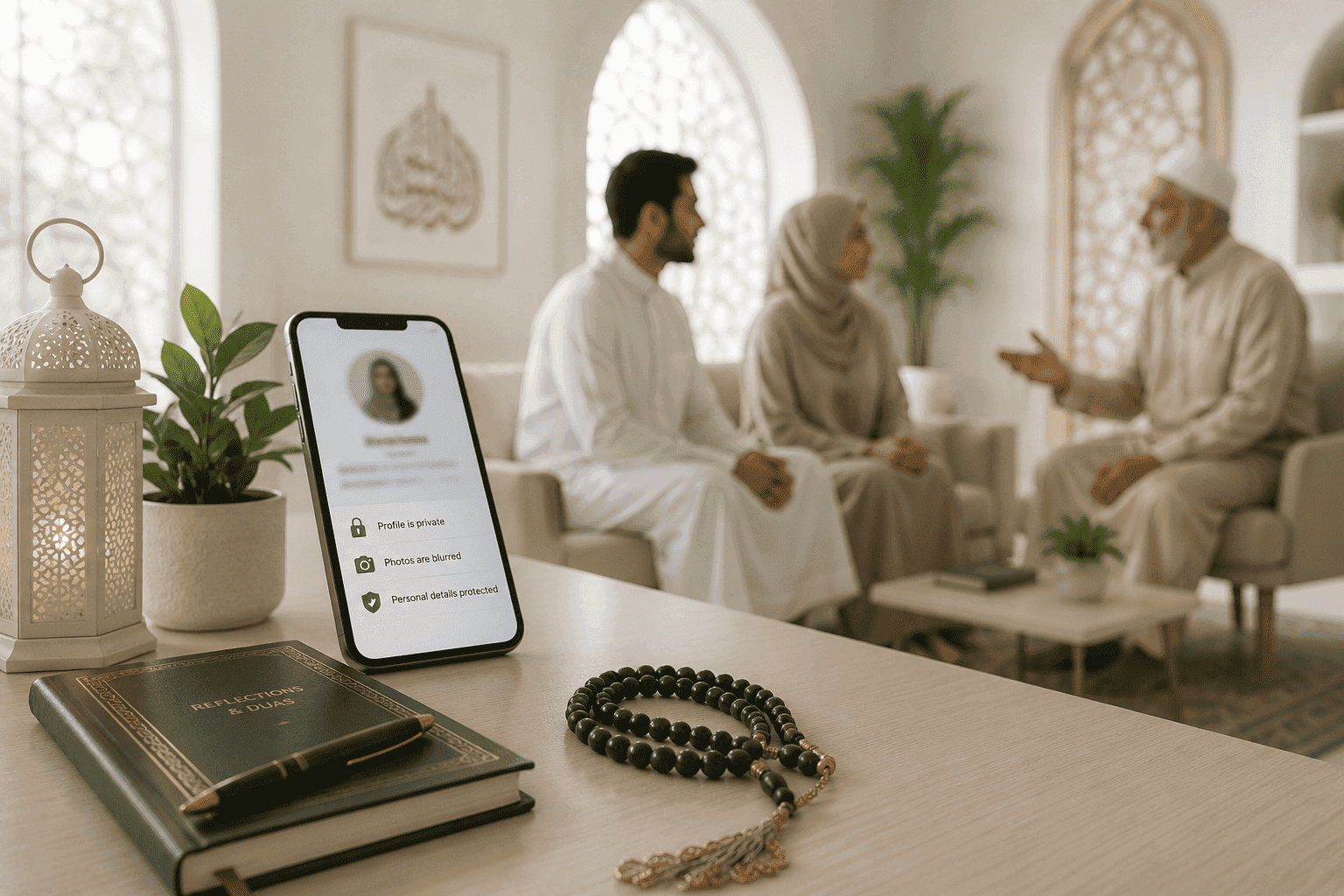
Safety in Muslim matrimony is not limited to avoiding fake accounts. It includes financial safety, photo privacy, free consent, emotional boundaries, family accountability, and the ability to end contact without intimidation.
Trust should grow through consistent evidence over time. It should never be demanded as proof of affection or religiosity.
Immediate online scam warnings
The US Federal Trade Commission’s romance-scam guidance describes a common pattern: a fake profile builds trust, moves the conversation away from the original platform, claims an urgent problem, and asks for money through methods that are difficult to reverse.
Never send money, gift cards, cryptocurrency, account access, or financial documents to an online match.
Stop the interaction if someone asks you to:
- pay for a visa, flight, medical emergency, customs fee, or blocked account;
- receive or transfer money on their behalf;
- buy gift cards or cryptocurrency;
- share banking credentials, one-time codes, or identity documents;
- invest through a link or adviser they introduced;
- keep the request secret from family or your bank.
Even a small first request may be a test. Do not send money to “prove” trust.
Red flags across the matrimony process
| Warning sign | Why it matters | Safer response |
|---|---|---|
| Immediate declarations of love | Creates commitment before evidence | Slow down and involve a trusted person |
| Refusal to speak with family | Avoids accountability | Pause until appropriate introductions occur |
| Inconsistent name, age, job, or location | May indicate deception or a stolen profile | Ask calmly, preserve records, and verify independently |
| Pressure for private photos | Tests whether boundaries can be overridden | Decline and use controlled photo access |
| Demands to leave the platform immediately | Removes reporting records and platform safety controls | Keep early communication in the safer channel |
| Repeated emergencies | Can prepare a financial request | Never send funds; discuss concerns with family |
| Anger after a boundary | Signals entitlement or control | End contact and report threats |
| Secrecy about marital status | Prevents informed consent | Do not proceed without clear, verifiable disclosure |
No single awkward message proves malicious intent. Patterns, pressure, and retaliation matter. You do not owe continued access while you investigate.
Controlling behaviour is not protective jealousy
Religious language can be misused to excuse control. The National Domestic Violence Hotline explains that abuse often centres on power and control; warning signs of abuse include extreme jealousy, isolation from family or friends, humiliation, financial control, intimidation, and pressure around sexual activity.
Watch for someone who:
- demands passwords or constant location access;
- dictates clothing, work, study, friendships, or family contact before commitment;
- frames every disagreement as disobedience;
- humiliates you and calls it advice;
- threatens self-harm, exposure, or family conflict if you leave;
- alternates intense affection with punishment or silence;
- refuses your right to say no.
Modesty, family involvement, and Islamic boundaries do not require surrendering safety or free consent.
If you feel at immediate risk, contact local emergency services. Specialist domestic-abuse organisations can help you assess danger and plan safely; do not confront a threatening person alone.
Protect photos and personal information
Treat every file sent to another person as potentially copyable. Watermarks and access controls reduce misuse but cannot make screenshots impossible.
Use these boundaries:
- Keep profile photos private or blurred until there is a genuine reason to share.
- Approve access for a limited purpose and revoke it when the introduction ends.
- Never send intimate images.
- Remove location metadata before sharing files outside a protected service.
- Avoid images that reveal your home, workplace, vehicle registration, children’s school, or routine.
- Report impersonation or image misuse promptly.
Read how private photo controls and reporting work on The Muslim Nikah. A trustworthy match will respect a reasonable privacy boundary even if they prefer a different pace.
Verify proportionately
Verification is a process, not a badge. The Muslim Nikah does not currently identity-verify every member, so independently confirm important claims and involve trusted family before making commitments.
For a serious introduction:
- involve family or a trusted Wali;
- use a live conversation rather than relying only on text;
- compare details shared at different times;
- arrange safe, appropriate meetings when feasible;
- confirm material work, family, or marital claims lawfully and with consent;
- use formal background-check services only where lawful and relevant;
- seek legal advice for immigration, marriage registration, or major financial commitments.
For cross-border introductions, browse the relevant Canada, United States, United Kingdom, India, or UAE hub, but verify civil marriage and immigration rules with the relevant government authority.
What to do when something feels wrong
- Pause. Do not let urgency set the timetable.
- Tell someone you trust. Secrecy makes manipulation easier.
- Preserve evidence. Save relevant messages, usernames, dates, and payment details without redistributing private material.
- Block and report. Use the platform’s safety tools.
- Contact financial providers immediately if money or credentials were shared.
- Report fraud locally. In the US, the FTC directs users to ReportFraud.ftc.gov; other countries have their own fraud-reporting authorities.
- Get specialist help if there are threats, stalking, coercion, or abuse.
The Wali and family guide explains how early accountability can reduce isolation. For a complete start-to-finish process, use the halal Muslim matrimony guide.
A final rule
Do not ask whether a boundary will offend a genuine person. Ask whether a genuine person can respond to that boundary with patience and respect. Their response is information.
Frequently asked questions
A request for money, gift cards, cryptocurrency, account access, or financial help from someone you have not independently verified is a major warning. Stop and speak with someone you trust.
Not always, but rushing to an unmoderated channel can remove safety controls and reporting records. Build trust first and involve family before sharing private contact information.
End contact, preserve relevant evidence, block and report the account, tell a trusted person, and contact local emergency or specialist support if you feel unsafe.