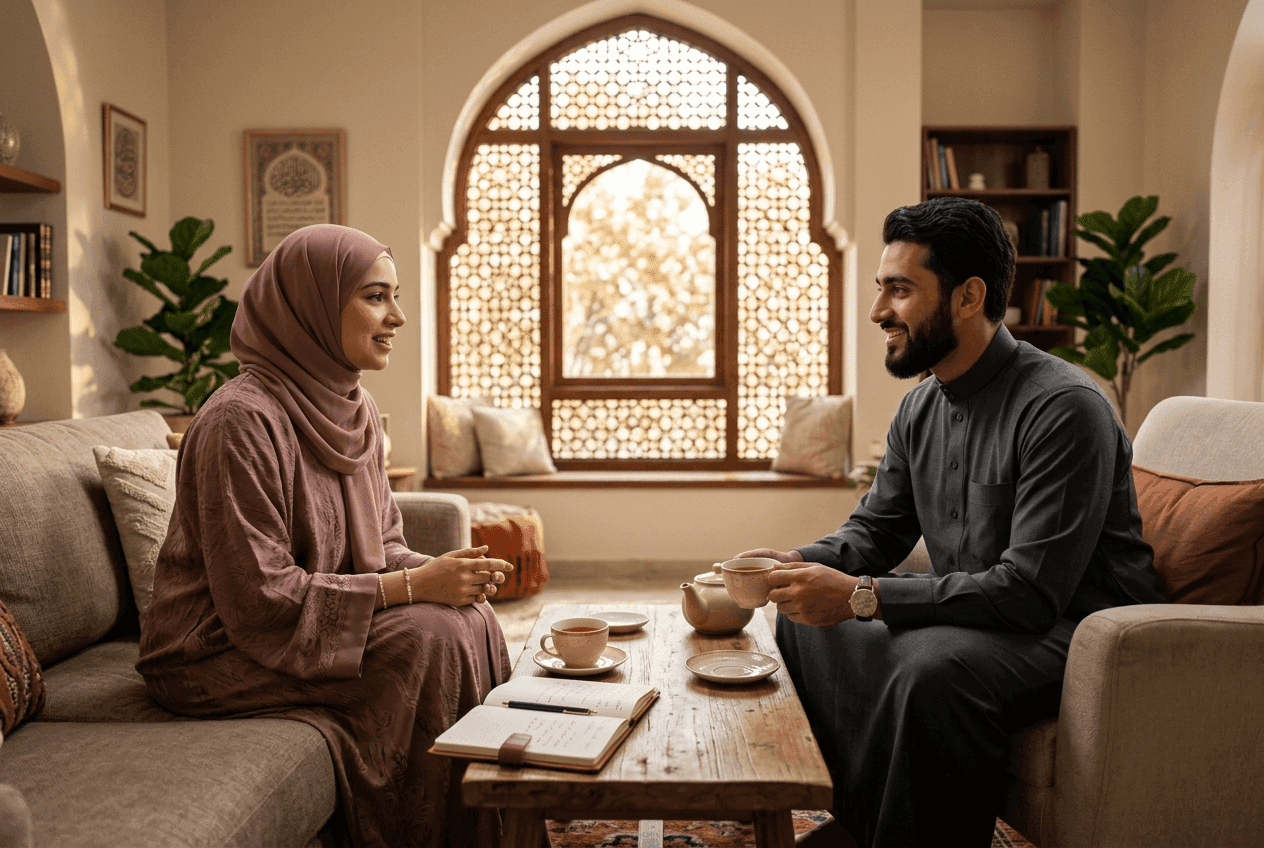
The purpose of premarital questions is not to catch someone giving a wrong answer. It is to discover whether two people can build a truthful, safe, and workable life together.
Start with deal-breakers, then explore detail over several conversations. Keep family or a trusted Wali appropriately involved, and remember that consent belongs to the people entering the marriage. Consultation and permission are essential steps in marriage.
A useful answer includes a principle, a real example, and what the person is still learning.
How to use these questions
Do not read them like an interrogation script. Choose a few from each section, answer them yourself, and ask follow-up questions such as “What would that look like in an ordinary week?” or “Can you give me an example?”
| Weak approach | Better approach |
|---|---|
| Ask all questions in one call | Revisit important subjects across several conversations |
| Accept labels such as “family-oriented” | Ask what responsibilities and boundaries the label includes |
| Search for identical answers | Look for compatible values and workable differences |
| Hide your own position | Answer with the honesty you expect from the other person |
Faith and religious practice
- What does practising Islam look like in your ordinary week? Discuss prayer, learning, community, halal income, modesty, and how each person responds after falling short.
- Which religious matters are essential in your home? Name concrete expectations rather than assuming shared labels mean shared practice.
- How do you handle legitimate differences of scholarly opinion? Look for humility, respect, and a plan for seeking qualified guidance.
- How should faith influence major decisions? Consider work, money, children, education, social life, and care for parents.
- What Islamic atmosphere do you hope to create at home? Ask who will initiate learning, worship routines, and community involvement.
Religious guidance places faith and character among the central considerations in spouse selection. Religious language alone is not proof of character, so ask how values appear in behaviour.
Character and communication
- What happens when you are angry? Ask about tone, withdrawal, repair, and whether insults or threats are treated as unacceptable.
- Tell me about a recent conflict you handled well—and one you handled badly. Self-awareness matters more than a flawless story.
- How do you apologise? A real apology acknowledges impact, repairs harm, and changes behaviour.
- How much daily communication do you expect? Compare preferences for messages, calls, privacy, and time alone.
- What behaviour would make you feel disrespected or unsafe? Both people should be able to set boundaries without retaliation.
If you notice pressure, control, secrecy, or intimidation, pause the process and review the Muslim matrimony safety checklist.
Family, Wali, and community
- What role should parents and relatives have after marriage? Discuss advice, decision-making, visits, caregiving, and privacy.
- Where do you expect to live during the first two years? Clarify living with family, nearby housing, or relocation.
- How will we respond when a spouse and a parent disagree? Look for fairness rather than automatic loyalty to one side.
- Which family traditions matter to you? Separate culture, preference, and religious obligation respectfully.
- How involved should a Wali or trusted family member be during this process? Agree on accountability without silencing either prospective spouse.
Read the Wali and family involvement guide before setting permissions or expectations.
Money, work, and household responsibilities
- What income, debt, and financial obligations should be disclosed before marriage? Material obligations should not be surprises.
- How do you budget, save, give, and spend? Ask for habits, not just intentions.
- What are your expectations about paid work after marriage? Discuss both spouses, career changes, childcare, and relocation.
- How should household work be divided? Use a real weekly scenario involving cooking, cleaning, errands, and invisible planning work.
- Which financial decisions require joint agreement? Consider large purchases, support for relatives, investments, and borrowing.
Financial compatibility does not require equal income. It requires transparency, fairness, and an agreed way to make decisions.
Children, health, and care
- Do you want children, and what if the journey is different from the plan? Discuss timing, fertility uncertainty, adoption or fostering views, and emotional support.
- What are your expectations for children’s Islamic and general education? Include schooling, language, discipline, and community.
- How do you understand fair discipline? Any use of fear, humiliation, or violence deserves serious attention.
- Which health information should we share before commitment? Material physical and mental health information should be discussed compassionately and privately.
- How would we care for a spouse during illness or disability? Ask about practical, emotional, and financial responsibilities.
Qualified premarital counselling can create a safe structure for sensitive conversations. Questions are a beginning, not a clinical, legal, or religious assessment.
Future plans and decision-making
- Where do you hope to live in five years? Include country, immigration realities, career, parents, and community.
- What does a satisfying ordinary life look like? Weekends and routines often reveal more than idealised goals.
- How will we make a decision when we strongly disagree? Agree on consultation, time-outs, trusted advice, and what cannot be compromised.
- What are your expectations for friendships and social media after marriage? Discuss privacy, opposite-sex boundaries, posting family life, and device access without normalising surveillance.
- What would make either of us pause or end this process? A respectful exit should remain possible until both people freely choose commitment.
Turn answers into a compatibility record
After each serious conversation, privately note:
- what was clearly agreed;
- what remains different but manageable;
- what needs verification or expert advice;
- what felt pressured, vague, or inconsistent;
- the next conversation and who should join it.
Compare the results with the practical Muslim marriage compatibility checklist. If you are searching for a practicing spouse, explore The Muslim Nikah platform or read how to write a trustworthy Muslim matrimony profile so important expectations are visible early.
The right conversation will not make two people perfectly certain. It should make them better informed, more honest, and freer to choose.
Start Your Halal Spouse Search Today
Are you ready to meet compatible, practicing Muslim singles for a blessed Nikah?
- The Muslim Nikah Matrimony — Visit our homepage to find practicing single Muslims on a private, halal matchmaking platform with Wali support and photo security.
- Register Your Free Matrimony Profile — Create a private profile with photo security, detailed religious practice criteria, and Wali involvement.
- Explore Muslim Matrimony UAE & Dubai — Connect with practicing single Muslims across the UAE, UK, North America, and South Asia.
- How to Pray Istikhara for Marriage — Step-by-step guidance on praying Istikhara, authentic Dua, and understanding the outcome.
- Browse Muslim Matrimony Profiles — Explore profiles by location, mother tongue, and sectarian background.
- Read the Complete Nikah Preparation Checklist — Everything you need to prepare for your upcoming Nikah ceremony.
Frequently asked questions
Discuss core deal-breakers early, then explore detailed expectations as mutual interest develops. This prevents avoidable attachment before major incompatibilities are known.
A trusted family member or Wali can improve accountability and notice unanswered questions, but both prospective spouses must still speak honestly and give free consent.
Yes. Purposeful, respectful conversation with the knowledge or presence of a Wali or family member is encouraged to evaluate religious practice, character, and compatibility.
The primary topics include daily faith practice, financial transparency and Mahr, conflict management habits, living arrangements, family boundaries, and expectations for children.
No. They are a structured starting point. Qualified premarital counselling can help couples examine patterns, expectations, and difficult subjects more deeply.