Entering marriage is one of the most consequential decisions a Muslim will ever make. While Islam encourages thorough consultation, practical due diligence, and rational compatibility checks, spiritual consultation with the Creator through Salat al-Istikhara is the essential anchor for finding peace in your choice.
The Prophet Muhammad (peace be upon him) taught his companions to pray Istikhara in all their affairs just as he would teach them a surah from the Quran. When seeking a life partner, Istikhara offers clarity, barakah (divine blessing), and heart-level reassurance.
Istikhara is not about abdicating your intellect or waiting for magic; it is seeking Allah's guidance to facilitate what is good and turn away what is harmful.
What is Istikhara for marriage?
Salat al-Istikhara literally means the prayer of seeking good. It is a sunnah prayer consisting of two non-obligatory (nafl) units (rak'ahs) followed by a specific, authentic supplication taught directly by the Messenger of Allah (peace be upon him).
Many people hold the misconception that Istikhara should be prayed before even researching a prospective spouse. In Islamic tradition, however, action and contemplation precede Istikhara. You must first investigate character, ask important compatibility questions, confirm religious values, and consult family members. Once you have done your due diligence and feel inclined toward a decision, you turn to Istikhara to ask Allah to facilitate the union if it is beneficial, or to create an honorable barrier if it contains hidden harm.
| Aspect | Misconception | Islamic Reality |
|---|---|---|
| Timing | Pray before knowing anything about the person | Pray after research, consultation, and forming an initial inclination |
| Outcome | Expect a vivid dream, colour sign, or vision | Look for practical ease, inner tranquility, or emerging obstacles |
| Proxy | Asking parents or a pious person to pray for you | The prospective bride and groom must personally pray Istikhara |
| Repetition | Pray only once and wait passively | Can be repeated several times as the introduction progresses |
| Due Diligence | Relying on Istikhara instead of asking questions | Istikhara accompanies thorough due diligence; it does not replace it |
Step-by-step: How to pray Istikhara for marriage
Performing Salat al-Istikhara is simple, accessible, and can be done by any Muslim who knows how to perform standard prayers. Follow this step-by-step process:
- Perform complete Wudu (ablution): Ensure your body, clothes, and prayer area are pure.
- Form the intention (Niyyah): Intend in your heart to pray two rak'ahs of voluntary prayer for Istikhara.
- Pray two voluntary Rak'ahs: In the first rak'ah, recite Surah Al-Fatihah followed by any surah (many scholars recommend Surah Al-Kafirun). In the second rak'ah, recite Surah Al-Fatihah followed by another surah (such as Surah Al-Ikhlas).
- Complete the prayer: Sit in Tashahhud, send blessings upon the Prophet (peace be upon him), and conclude the prayer with the Taslim (turning right and left).
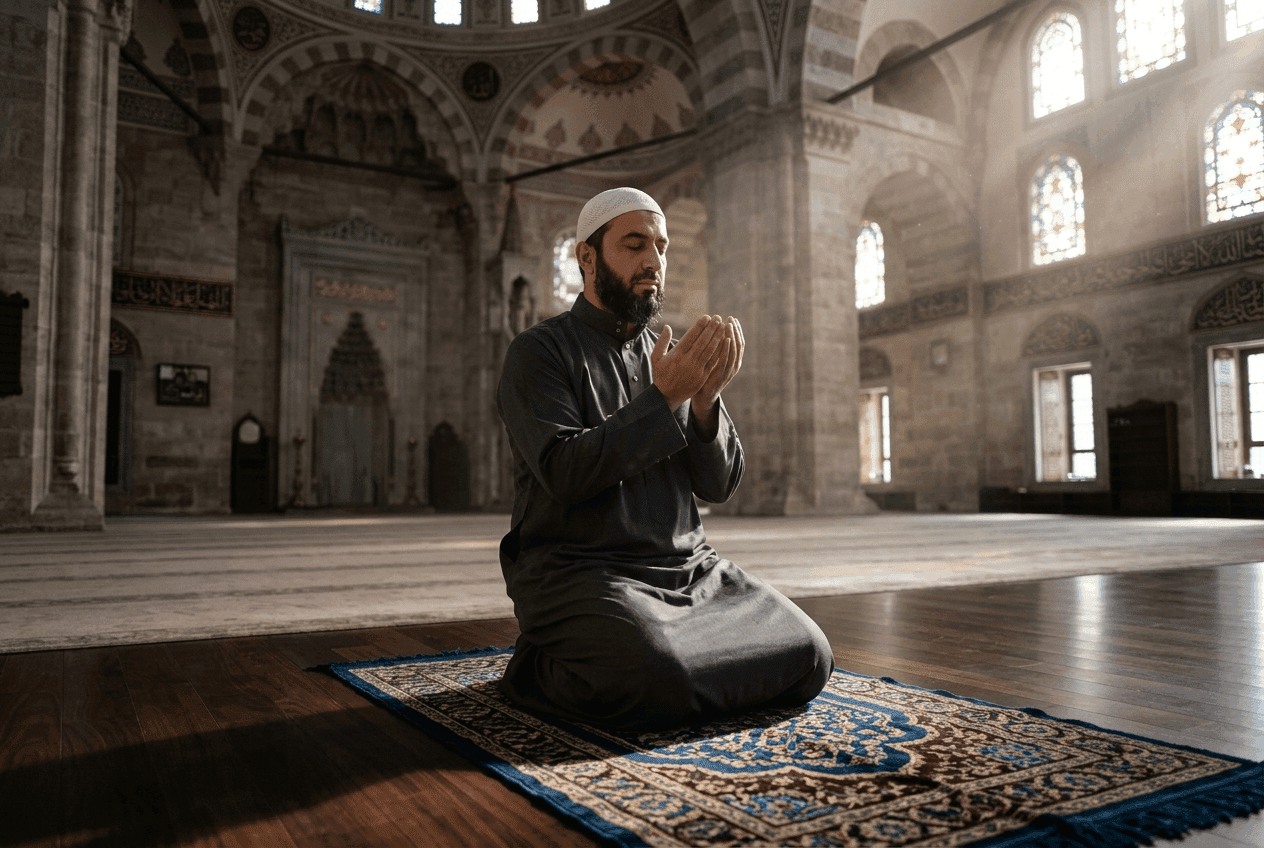
- Recite the authentic Istikhara Dua: Raise your hands in sincere supplication, praise Allah, send salawat upon the Prophet, and recite the Dua of Istikhara with presence of heart.
The authentic Dua of Istikhara
The Prophet (peace be upon him) taught the following specific words recorded in Sahih al-Bukhari:
Transliteration:
Allahumma inni astakhiruka bi'ilmika, wa astaqdiruka biqudratika, wa as'aluka min fadlika al-'azim, fa innaka taqdiru wa la aqdir, wa ta'lamu wa la a'lam, wa Anta 'Allamul-ghuyub. Allahumma in kunta ta'lamu anna hadha al-amra [name the marriage to this person] khayrun li fi deeni wa ma'ashi wa 'aqibati amri, faqdurhu li wa yassirhu li thumma barik li feeh. Wa in kunta ta'lamu anna hadha al-amra sharrun li fi deeni wa ma'ashi wa 'aqibati amri, fasrifhu 'anni wasrifni 'anhu, waqdur liya al-khayra haythu kana thumma ardini bih.
English Translation:
"O Allah, I seek Your counsel through Your knowledge, and I seek ability through Your power, and I ask You from Your immense favor. For You are capable and I am not, and You know and I do not, and You are the Knower of the unseen. O Allah, if You know that this matter [marriage to this individual] is good for me in my religion, my livelihood, and the outcome of my affairs, then decree it for me, make it easy for me, and bless me in it. But if You know that this matter is bad for me in my religion, my livelihood, and the outcome of my affairs, then turn it away from me, and turn me away from it, and decree for me what is good wherever it may be, and make me content with it."
When you reach the phrase hadha al-amra (this matter), mention the specific person you are considering for marriage.
Understanding the signs: How does Allah answer Istikhara?
One of the most persistent cultural myths is that one must see a dream with green or white colors indicating approval, or red and black colors indicating refusal. Classical scholars have clarified that dreams are neither required nor guaranteed following Istikhara.
Instead, the answer to Istikhara manifests in three primary ways:
- Facilitation and ease: If the marriage is good for your faith and future, practical steps begin to fall into place smoothly. Conversations flow respectfully, families agree on terms, and logistical barriers clear away.
- Barriers and honorable separation: If the match contains hidden harm, obstacles arise naturally. Communication breaks down, core incompatibilities surface, or one or both families express genuine reservations without malice.
- Clarity of heart: A feeling of peace, contentment, and resolved hesitation, or conversely, an enduring spiritual unease that does not fade even when superficial details look attractive.
Remember the wording of the dua: “turn it away from me, and turn me away from it, and make me content with it.” If things fall through after Istikhara, treat the conclusion with gratitude and trust rather than despair.
Connecting Istikhara with practical compatibility
Spiritual prayer must never be used as an excuse to avoid asking difficult questions. A successful marriage is built on shared faith, emotional safety, financial transparency, and mutual consent.
Before finalizing your decision:
- Review the 30 questions to ask before marriage in Islam to ensure no fundamental topic has been overlooked.
- Work through the practical Muslim marriage compatibility checklist covering finances, communication, and family boundaries.
- Adhere to safe introductory etiquette outlined in our halal spouse search guide and stay aware of online matrimony safety red flags.
- Ensure your Wali or family members are actively involved in early conversations to preserve dignity and accountability.
By combining sincere Istikhara with thorough premarital communication, you place your trust in Allah with both faith and action.
Begin Your Blessed Search with The Muslim Nikah
If you are looking for a practicing Muslim partner who values faith, family involvement, and privacy:
- Register Your Free Matrimony Profile — Create a private profile with photo privacy controls, religious compatibility criteria, and Wali co-management.
- Browse Muslim Matrimony Profiles — Explore practicing Muslim profiles across North America, the UK, Europe, and the Middle East.
- Review the Nikah Preparation Checklist — Ensure all contractual, legal, and spiritual requirements are organized before your wedding day.
Frequently asked questions
Pray Istikhara after you have investigated compatibility, asked premarital questions, consulted your family, and formed an initial inclination toward a prospective spouse.
No. Authentic scholarship confirms dreams are not required. Allah answers Istikhara through practical ease, emerging clarity of heart, or natural removal of obstacles.
No. The prospective bride and groom should each pray Istikhara personally. Family members can offer general Dua, but personal Istikhara cannot be performed by proxy.
If the match contains hidden harm, communication frequently breaks down, irreconcilable differences emerge, or persistent hesitation replaces confidence despite good intentions.